
Why Flushing Your Drip System Wrong Could Be Ruining Your Yields
Drip irrigation is a long-term investment. But like any high-performance system, it only delivers consistent results if it’s properly maintained. One of the most overlooked and misunderstood components of this maintenance is flushing. Without proper maintenance, even the best-designed systems lose performance over time.
“A mistake we see is that sometimes growers may think they are flushing their lines, but they’re not achieving the water velocity needed to remove debris,” says Matt Clift, Director of Global Product Management & Marketing from Rivulis. “Without velocity, eventually sediment build-ups and clogs the drip lines.”
What Flushing Really Means
Flushing isn’t just about opening the end of a line. To be effective, the line ends are opened, but water must move through the system fast enough to carry debris out.
For laterals, this means achieving a minimum velocity of 0.3 meters (1 ft) per second. Submains require even more, around 0.5 meters (1.5 ft) per second. Without these velocities, debris such as silt and clay that pass through the filtration system can coagulate to larger material within the pipes over time. In other words, the key to flushing is velocity.
A key point of caution about relying on self-flushing line ends. These small ‘normally open’ valves close when the water reaches a certain pressure. This creates a short flush which provides benefits, but they do not increase the velocity. They are not a replacement for correct flushing.
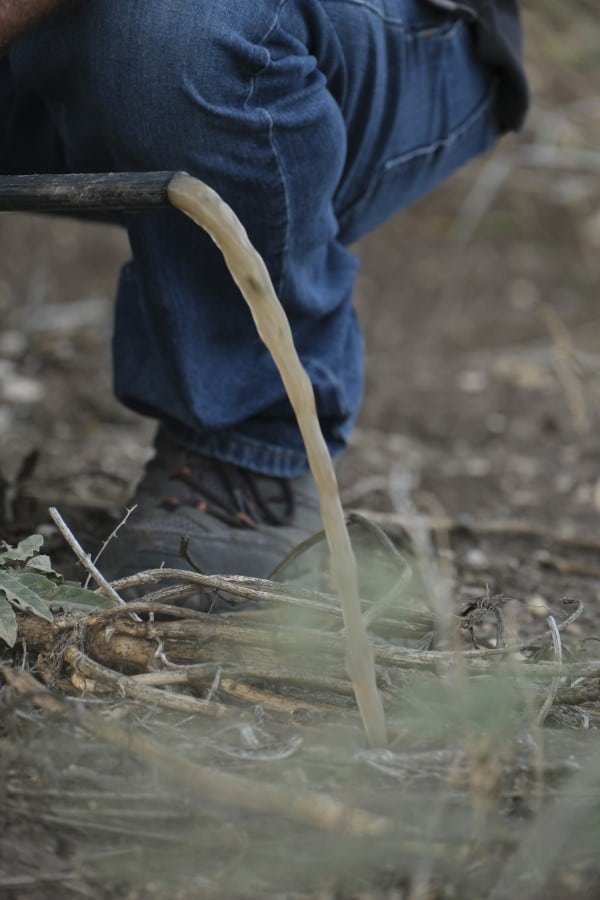
Key points about flushing
Growers should flush systems at the start and end of each season and during the season. How often during the season depends on water quality, what is the intended life span of the drip laterals, and how much water flows through the system each season. Lower water quality, multi-season drip line use, and higher irrigation volumes being applied, all lead towards a need to flush more.
Flushing should be in order of main lines, submains, and then drip laterals.
How to know when the flush is complete is important. You will first see dirty water expel from the tube, then clean water, then dirty water again, and then clean water. Do not stop at the first sign of clean water, it is important to wait for the second clear water stage before concluding.
Clean Drip Lines Protect Crop Investment
Clogged emitters lead to inconsistent irrigation, which leads to plant stress and lower yields. Furthermore, unseen debris build-up shortens the life of your irrigation system investment. Proper flushing isn’t glamorous, but it is one of the simplest ways to protect your system and ensure uniform irrigation.
To learn more about flushing techniques and performance benchmarks, Rivulis has developed a set of Drip Irrigation Guides that can be downloaded at https://www.rivulis.com/knowledge-hub/maintenance/. Flushing is contained in Book 4 and provides a detailed step-by-step guide on how to flush your system for maximum performance.
Discover more